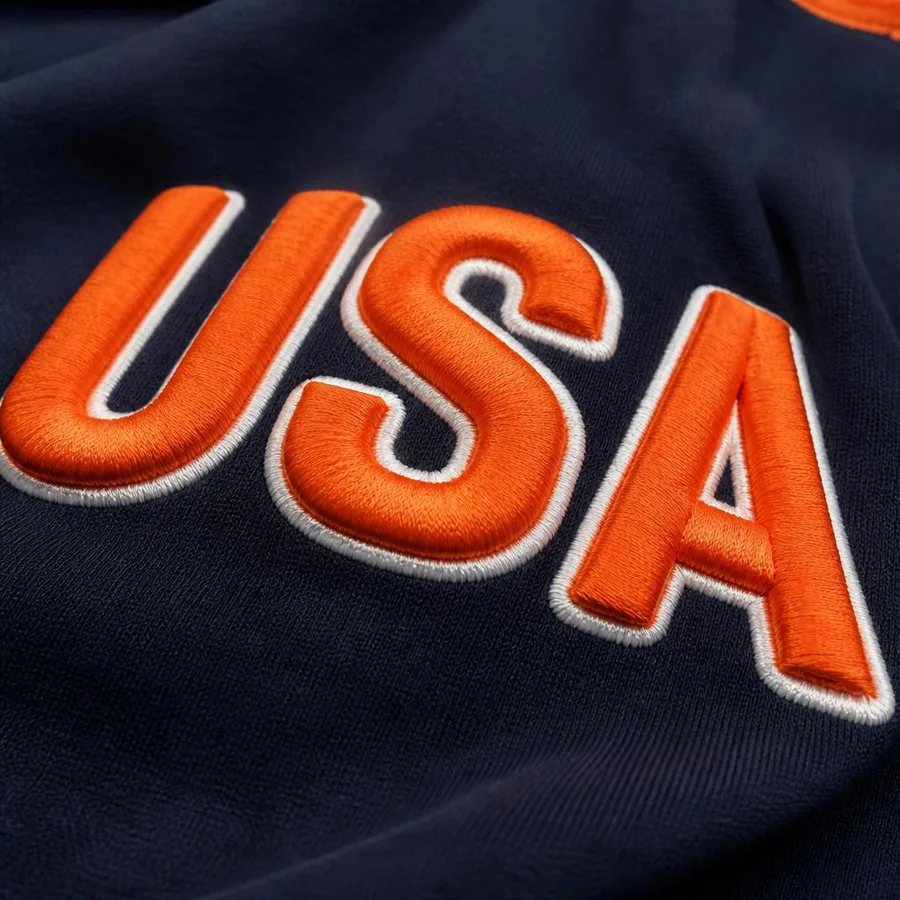
3D puff works best on bold, simple shapes and thick block lettering: think team names, initials and chunky icons on a cap front. Every puffed part needs to be a satin column roughly 3 to 10 mm wide, with letters at least about half an inch tall. Thin script, tiny text, gradients and fine detail don't puff well, but they can sit next to the puff as flat embroidery.
Puffs well
Keep it flat
How 3D puff works
For puff, the machine first sews any flat parts of the design. Then it stops, the operator lays a sheet of embroidery foam over the area, and the machine sews the puff parts right over it. The stitches are dense and close, so at the edges the needle perforates the foam, and the leftover foam tears away cleanly. What stays under the thread is a raised, rounded shape.
That's also why puff needs its own stitch file. A regular file uses fill stitches and normal density, which would flatten the foam or leave it peeking out. A puff file uses satin columns, extra density, closed ends and a stop for the foam.
6 design rules for clean puff
Good and poor candidates
Not ideal for puff
- Thin script or handwriting fonts
- Small text under about half an inch
- Photos, gradients and shading
- Hairline outlines and tiny details
- Large solid backgrounds or boxes
Great for puff
- Team names and varsity letters
- Two or three bold initials
- Numbers on caps and jackets
- Simple icons with thick strokes
- A puffed main word with small flat text
If your logo has both, that's fine. We'll suggest which parts to puff and which to keep flat, and you see it on the approval sheet before anything is sewn.
Where 3D puff works best
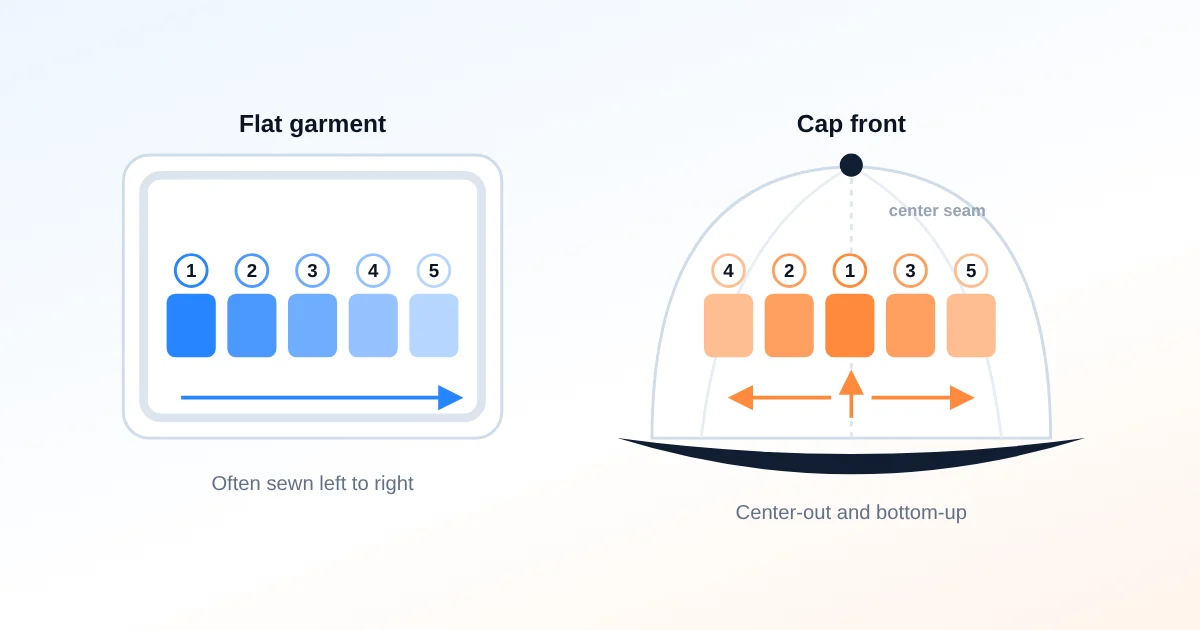
Structured caps are the classic home for puff. The firm front panel holds the raised letters in shape and the curve shows them off. Jackets, hoodies and heavier sweatshirts work well too. Thin, stretchy T-shirts aren't a good match, because the fabric can't hold dense, raised stitching flat. Caps also need their own sewing order, which we cover in cap vs flat digitizing.
Matching the foam. Foam usually comes in black, white and a few colors. Pick the one closest to your thread color, so that if a stitch spreads slightly, nothing odd shows through. Your embroiderer will usually have this covered.
What to send for a 3D puff file
- 1Your logoAny format is fine. A vector or a large, clear image is best, but a photo or screenshot works too.
- 2Size and placementFor example cap front, 2.25 inches tall. The size decides what can puff and what should stay flat.
- 3Which parts to puffTell us if you have a preference. If not, we'll recommend it and show you on the approval sheet.
3D puff digitizing costs the same as a regular left chest or cap file with us, and it comes with the DST, your machine format, the EMB working file and a PDF approval sheet. More on the service in 3D puff embroidery digitizing. If you'd rather have puff on a patch instead of directly on the cap, see our 3D puff patches.
3D puff FAQs
What kind of logo works best for 3D puff?
Bold, simple shapes and thick block lettering, like a team name, initials or a chunky icon. Each part needs to be wide enough to sew as a satin column over the foam, so heavy sans-serif or varsity fonts work far better than thin script.
How small can 3D puff lettering be?
We like puff letters to be at least about half an inch tall, with strokes around 3 mm wide or more. Smaller text can still go on the same cap, sewn flat next to the puff parts.
Can you mix 3D puff and flat embroidery in one design?
Yes, and it's often the best look. The main word or icon is puffed and the small text, outlines and details are sewn flat. The flat parts are sewn first and the foam goes down for the puff parts at the end.
Does 3D puff digitizing cost more?
Not with us. A 3D puff file is priced the same as a regular left chest or cap file of the same size. It does need its own file, though, because puff is digitized differently from flat embroidery.
Can I use my regular embroidery file for 3D puff?
No. A flat file uses fill stitches and normal density, which would flatten and cut the foam. Puff needs satin columns, higher density, closed ends and a stop for the foam, so it has to be digitized for puff.
What garments work for 3D puff?
Structured caps are the classic, and it also works well on jackets, hoodies and sweatshirts. Thin, stretchy T-shirts aren't a good match because the fabric can't hold the raised stitching flat.
Have a logo you want in 3D puff?
Send it with the size and placement. We'll tell you which parts will puff well and digitize it for the same price as a flat cap file.
Get a 3D Puff Quote →